University vs. University of Applied Sciences vs. Technical University: Which Is Right for You?
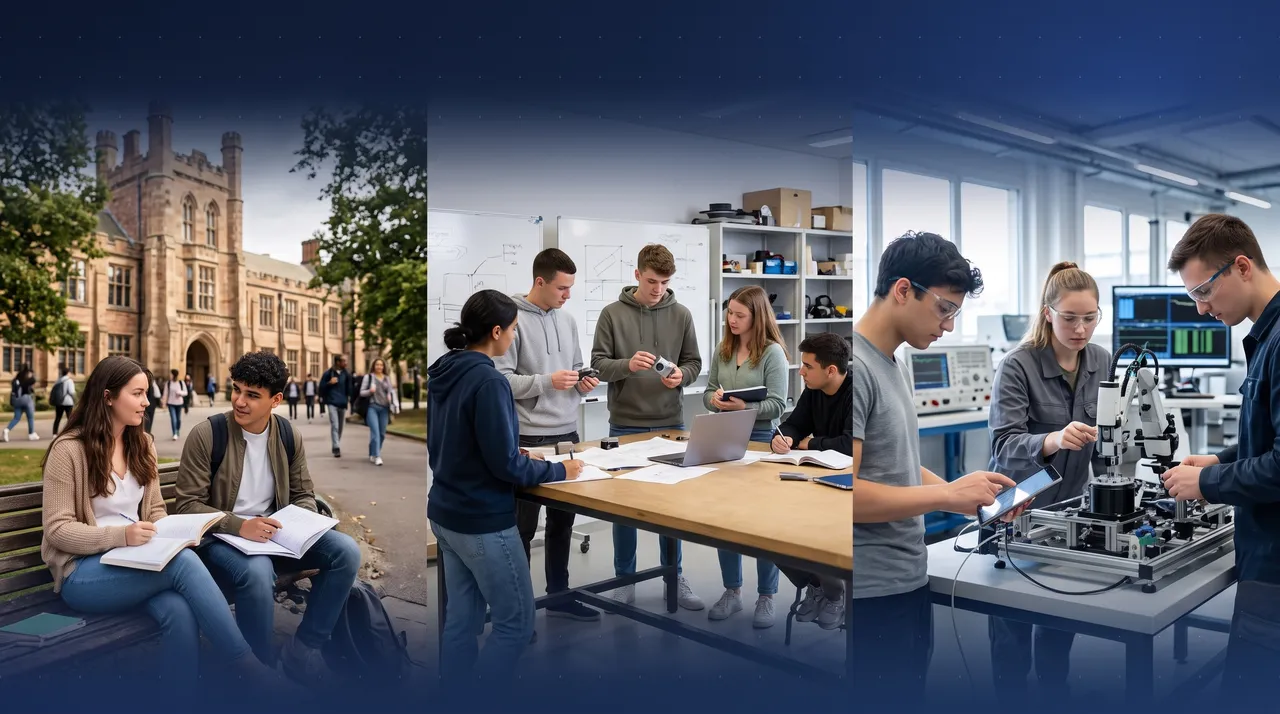
Germany has three main types of higher education institutions: universities, universities of applied sciences and technical universities. All of them award internationally recognised bachelor's and master's degrees, but they differ in how they teach, how practical the studies are and where your career can lead afterwards.
If you come from a country where "university" is the only option, this system can be confusing. Many international students apply only to universities and overlook universities of applied sciences, even though these might suit their goals much better. This guide explains the differences so you can choose the right type of institution for your plans.
The three types at a glance
| University (Universität) | University of Applied Sciences (Fachhochschule / HAW) | Technical University (TU) | |
|---|---|---|---|
| Focus | Theory and research | Practice and application | Engineering, natural sciences, technology – research-based |
| Teaching style | Large lectures, self-study, academic freedom | Smaller groups, fixed timetables, closer contact to professors | Like a university, with a strong technical profile |
| Subjects | Full range, incl. medicine, law, pharmacy, teacher training | Engineering, business, IT, social work, design, health | Engineering, computer science, natural sciences, architecture |
| Practical phases | Optional, depends on the programme | Usually a mandatory internship semester | Often internships, many industry projects |
| Professors | Academic careers, strong research record | At least 5 years of professional experience, 3 of them outside academia | Academic careers, strong research and industry links |
| PhD | Yes | Generally no (exceptions in some federal states) | Yes |
| Best for | Research, academic careers, regulated professions | Fast entry into the job market | Engineering and tech careers, research in technology |
Universities (Universität)
Universities are the classic, research-oriented institutions. They teach the theoretical foundations of a subject and train students to think scientifically. Many German universities are centuries old, such as Heidelberg University (founded in 1386).
Universities offer the widest range of subjects. Some fields can only be studied at a university, including medicine, dentistry, pharmacy, law and teacher training.
Studying at a university means a lot of independence. You often choose your own courses, attendance is rarely checked and you are expected to organise your learning yourself.
Advantages
- Widest choice of subjects and specialisations
- Strong research focus and international reputation
- Direct path to a PhD and an academic career
- Access to regulated professions such as medicine and law
Disadvantages
- Large lectures, especially in the first semesters
- Less personal support – self-discipline is essential
- Less practical experience unless you seek it out yourself
- Programmes can take longer than the standard period of study
Universities of Applied Sciences (Fachhochschule / HAW)
Universities of applied sciences – in German Fachhochschule (FH) or Hochschule für Angewandte Wissenschaften (HAW) – focus on applying knowledge in practice. Their aim is to prepare you directly for a job. In English they often simply call themselves "University of Applied Sciences".
Their professors must have several years of professional experience outside academia, so teaching is closely linked to real business problems. Most bachelor's programmes include a mandatory internship semester, and many students write their final thesis in cooperation with a company.
Study life is more structured than at a university: smaller groups, fixed timetables, seminars and lab work instead of huge lectures. Bachelor's programmes often last 7 semesters instead of 6 because of the practical semester.
Advantages
- Strong practical orientation and close contact with companies
- Smaller classes and personal support from professors
- Internships and company-based theses help you find your first job
- Very good reputation with German employers, especially in engineering, IT and business
Disadvantages
- Narrower range of subjects (no medicine, law or teacher training)
- Usually no right to award doctorates – you need a university partner for a PhD
- Less known abroad, which can matter if you plan to return home
- Fewer English-taught programmes than at large universities
Technical Universities (TU)
Technical universities are universities with full research status and a focus on engineering, computer science and the natural sciences. Legally they are universities: they award doctorates and conduct top-level research. Many also offer economics, humanities or social sciences, often with a technical angle.
Nine of the leading technical universities form the TU9 alliance:
- RWTH Aachen University
- TU Berlin
- TU Braunschweig
- TU Darmstadt
- TU Dresden
- Leibniz University Hannover
- Karlsruhe Institute of Technology (KIT)
- Technical University of Munich (TUM)
- University of Stuttgart
TUs work closely with industry – think automotive, mechanical engineering, chemicals and IT. Germany's engineering reputation is built to a large extent on these institutions.
Advantages
- Excellent international reputation in engineering and tech
- Strong research plus close links to industry
- PhD possible directly at the institution
- High demand for graduates on the German job market
Disadvantages
- Demanding programmes with high dropout rates in the first semesters
- Very competitive admission, especially for international master's programmes
- Theory-heavy foundations (maths, physics) in the first years
- Large lectures, similar to classic universities
Other types of institutions
Cooperative State Universities (Duale Hochschule) combine studying and working. You sign a contract with a company, alternate every three months between campus and workplace and receive a monthly salary throughout your studies. The best-known example is the Baden-Württemberg Cooperative State University (DHBW). Dual programmes are also offered by many universities of applied sciences. To apply, you usually need a company contract first – and good German skills.
Colleges of art, film and music (Kunst- und Musikhochschulen) train artists, designers, musicians and actors. Admission is based mainly on an aptitude test or portfolio, not only on grades.
Are the degrees worth the same?
Yes. Since the Bologna reform, all three types award the same bachelor's and master's degrees with ECTS credits. A master's degree from a university of applied sciences formally qualifies you for a PhD, just like one from a university.
The differences show up in three places:
- PhD: Universities and TUs can award doctorates. Universities of applied sciences generally cannot – you do your PhD in cooperation with a university. Some federal states, such as Hesse and Baden-Württemberg, now give research-strong universities of applied sciences limited doctoral rights.
- Job market: German employers know the system well and value FH graduates for their practical experience. In engineering, IT and business, graduates of all three types have very good job prospects.
- Reputation abroad: In some countries, the term "university of applied sciences" is less familiar. If you plan to work in your home country later, check how degrees are recognised there.
Tuition is the same across the types: public institutions in Germany generally charge no tuition fees, only a semester contribution. Baden-Württemberg is an exception and charges tuition fees for most non-EU students.
Which one is right for you?
Choose a university if you …
- want to study medicine, law, pharmacy or become a teacher
- are interested in research or an academic career
- like working independently and enjoy theory
- want the widest choice of subjects and specialisations
Choose a university of applied sciences if you …
- want to start working as soon as possible after graduation
- learn best in small groups with a clear structure
- want real work experience through internships and company projects
- plan to stay and build your career in Germany
Choose a technical university if you …
- want to become an engineer, computer scientist or natural scientist
- are strong in maths and physics
- are aiming for top international employers or research in technology
- want the option of a PhD in a technical field
Tip: Look at the individual study programme, not only the type of institution. A programme's curriculum, language of instruction, location and admission requirements often matter more than the label.
Frequently asked questions
Can I switch from a university of applied sciences to a university for my master's? Yes. A bachelor's degree from a university of applied sciences qualifies you for a master's at a university. Some programmes may ask you to complete extra courses if your bachelor's was less theoretical.
Is "Hochschule" the same as "university"? "Hochschule" is the umbrella term for all higher education institutions in Germany. When an institution is just called "Hochschule", it is usually a university of applied sciences.
Are admission requirements different? Universities and TUs require a general higher education entrance qualification. Universities of applied sciences sometimes also accept a subject-specific entrance qualification. For international students, recognition of your school certificate works the same way for all types.
Do I need German for a university of applied sciences? Most bachelor's programmes are taught in German at all three types. English-taught programmes exist everywhere, but they are more common at master's level and at large universities and TUs.
Summary
There is no "better" or "worse" type of institution in Germany – only the one that fits your goals. Universities are ideal for research and regulated professions, universities of applied sciences for a practical path into the job market, and technical universities for engineering and tech careers at the highest level.