Scholarships for International Students in Germany
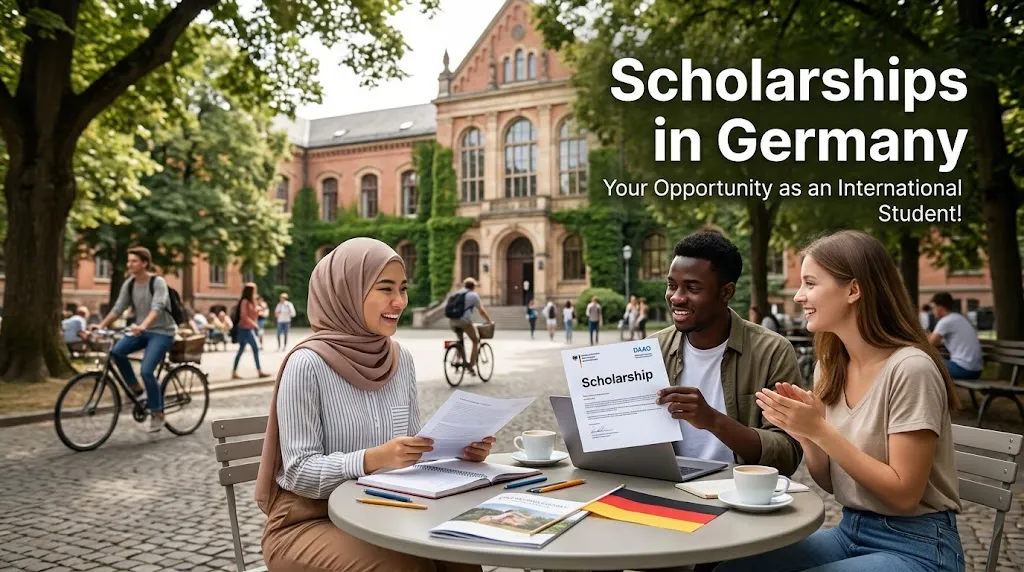
Studying in Germany is usually tuition-free at public universities – living costs are not. If you come from abroad to study, you should currently expect around €992 per month. Scholarships can close this gap fully or partly, don't have to be repaid and often open doors to networks and future jobs.
Why Germany – and what studying costs
Germany is one of the most popular study destinations in the world. The reasons: strong universities and universities of applied sciences, many English-taught master's programmes and a labour market that urgently needs skilled professionals – especially in engineering, IT, natural sciences and healthcare.
Public universities in most federal states charge no tuition fees, only a semester contribution of usually €150 to €400. An important exception is Baden-Württemberg: students from non-EU countries pay €1,500 per semester there. Private universities almost always charge fees.
The bigger cost item is living expenses. A good benchmark is the amount Germany requires for a student visa: €992 per month or €11,904 per year. In Munich, Frankfurt or Stuttgart this is often just about enough; in smaller university towns it goes further.
This is exactly where scholarships come in. They range from €300 per month to full funding including insurance and travel costs.
EU or non-EU: What applies to you
Your citizenship determines your visa, tuition fees, eligibility for BAföG (German state student aid) and your right to work. The key differences at a glance:
| Topic | EU/EEA and Switzerland | Non-EU (third countries) |
|---|---|---|
| Visa | not required, only registration at your place of residence | student visa (Section 16b Residence Act) |
| Proof of financial resources | not required | currently €11,904 for 12 months, usually via a blocked account |
| Tuition fees in Baden-Württemberg | none | €1,500 per semester (exceptions possible) |
| BAföG | possible under certain conditions | only in exceptional cases |
| Working alongside studies | no restrictions (same as Germans) | 140 full or 280 half days per year |
| Erasmus+ | yes, for exchange semesters | only via the university's partner programmes |
Students from the EU
Citizens of EU countries as well as students from Iceland, Liechtenstein, Norway and Switzerland are largely treated like German students. However, they are not automatically entitled to BAföG. Typical ways to qualify:
- You have lived legally in Germany for at least five years (permanent right of residence).
- You worked in Germany before your studies and your degree is related to that work.
- One of your parents has worked in Germany for a total of three years within the last six years.
If you come from another EU country specifically to complete a full degree, you usually won't meet these conditions. In that case, scholarships and a part-time job are your most important building blocks. One advantage: you can apply to the 13 German "Begabtenförderungswerke" (gifted student foundations) just like German students once you are eligible under Section 8 BAföG.
Students from non-EU countries
For your visa, you must prove that you can cover your living costs. The standard is a blocked account (Sperrkonto) with €11,904, from which €992 is released each month after you arrive. A scholarship can fully or partly replace this proof – for example a DAAD scholarship that covers your living costs.
Important: A partial scholarship – such as the Deutschlandstipendium with €300 per month – is not sufficient proof of funds on its own. You must prove the difference up to €992 separately, for example with a smaller blocked account. Always confirm the exact requirements with the German embassy or consulate in your country.
The most important scholarship providers
Most international students find their funding through six groups of providers. Which one suits you depends on your country of origin, study level and personal engagement.
1. DAAD – the largest funder for international students
The German Academic Exchange Service (DAAD) is the first port of call for anyone who wants to complete a full master's degree in Germany. The study scholarship for a master's degree includes:
- €992 per month for 10 to 24 months
- an annual study allowance of €460
- health, accident and personal liability insurance
- in many programmes, a travel allowance and an online language course
The DAAD does not cover tuition fees. You apply online via the my.daad.de portal; deadlines often fall between August and November – roughly one year before your studies begin. Doctoral candidates currently receive €1,400 per month. There are also dedicated programmes for professionals from developing and emerging countries with a development focus. You can find all programmes in the DAAD scholarship database.
2. Deutschlandstipendium – open to all nationalities
The Deutschlandstipendium provides €300 per month, independent of income, for at least one year. Half is paid by the federal government, the other half by private sponsors such as companies or foundations. It is open to students of all nationalities.
You apply directly to your university, usually in spring or summer for the following winter semester. Besides grades, engagement and personal circumstances count – for example a refugee background or being the first in your family to go to university. Many scholarship holders also gain contacts with their sponsoring companies, which makes starting a career easier.
3. The 13 gifted student foundations (Begabtenförderungswerke)
These foundations are funded by the federal government and are affiliated with political parties, churches, trade unions or business – or, like the German Academic Scholarship Foundation (Studienstiftung des deutschen Volkes), independent. They pay a basic scholarship based on BAföG rules plus a €300 study allowance. On top of that come seminars, networks and mentoring.
What matters for international students:
- EU citizens can usually apply like German students if they are eligible under Section 8 BAföG.
- Non-EU students mainly have a chance at master's level. The Heinrich Böll Foundation, for example, supports international students who completed their first degree in their home country. Before applying, check which study levels are currently funded, as the rules can change.
- The Friedrich Ebert Foundation, the Konrad Adenauer Foundation and others have their own programmes for international students and doctoral candidates.
It is important that your values and engagement match the foundation. Party membership is not required.
4. Erasmus+ – for exchange semesters
Erasmus+ funds study abroad semesters between European universities. If you come to Germany for one or two semesters, you usually receive €600 per month, as Germany belongs to the group of countries with higher living costs. You apply through the international office of your home university. For a full master's degree, there are the Erasmus Mundus Joint Masters, which are open to students from all over the world.
5. University and state scholarships
Many universities award their own scholarships for international students, such as degree completion scholarships or emergency grants. Ask at the international office. In Baden-Württemberg, the Baden-Württemberg-STIPENDIUM supports exchanges with partner universities with €600 to €1,400 per month for three to eleven months. Scholarship holders of the Baden-Württemberg Stiftung are also exempt from the tuition fees for non-EU students.
6. Private foundations and companies
Besides the major programmes, there are hundreds of smaller foundations – often with narrow criteria such as subject, country of origin or religion. That is actually an advantage: fewer applicants mean better chances. Good search tools are the DAAD database, mystipendium.de and the German government's "Stipendienlotse".
All programmes at a glance
The DAAD master's scholarship is the most comprehensive funding for students from abroad; the Deutschlandstipendium is the most accessible.
| Programme | Who it's for | Monthly benefit | Duration | Apply to |
|---|---|---|---|---|
| DAAD study scholarship (master's) | Graduates from abroad (EU and non-EU) | €992 + €460/year + insurance | 10–24 months | DAAD (my.daad.de) |
| DAAD doctoral scholarship | Doctoral candidates from abroad | €1,400 + insurance | depends on programme | DAAD |
| Deutschlandstipendium | Students of all nationalities | €300 | at least 12 months | your university |
| Gifted student foundations | mainly EU citizens eligible for BAföG; non-EU mostly at master's level | basic scholarship based on BAföG + €300 | standard period of study | the respective foundation |
| Erasmus+ | Exchange students from Europe | €600 | 1–2 semesters | home university |
| Baden-Württemberg-STIPENDIUM | Exchanges with partner universities in BW | €600–1,400 | 3–11 months | international office |
How to apply successfully
The earlier you start, the better your chances: plan 12 to 18 months before your studies begin.
- Define your goal. Bachelor's, master's or doctorate? Full degree or exchange semester? This determines which programmes are relevant at all.
- Research suitable scholarships. Use the DAAD database and the websites of your preferred universities. Keep a list of deadlines and requirements.
- Prepare your documents. Typically required:
- CV (often in tabular form, sometimes in DAAD format)
- motivation letter with a clear link to the programme
- certificates and transcripts, certified and translated if needed
- one or two letters of recommendation from professors
- language certificates (e.g. TestDaF, DSH, IELTS or TOEFL)
- admission letter or proof of application from the university
- Tailor your motivation letter to the programme. Explain why you want to study this particular subject in Germany and what you plan to do with it afterwards. For foundations, it also matters how you live their values – for example through volunteering.
- Submit on time. Many portals close at midnight German time. Build in a buffer in case references arrive late.
- Prepare for the selection interview. Many providers invite applicants to interviews, often online. Practise explaining your study goal in two minutes.
- Apply to several programmes. Apply to multiple programmes in parallel – but check whether they can be combined, as many scholarships exclude double funding.
Tips for a strong profile
- Good grades help, but rarely decide on their own. Engagement in clubs, volunteering or student groups is often just as important.
- German language skills are a plus even in English-taught programmes – for your studies, everyday life and future job.
- Get feedback: student advisory services, the international office or former scholarship holders are often happy to review your motivation letter.
Common mistakes
- Starting too late. DAAD deadlines often end in autumn of the previous year.
- Sending generic letters. Selection committees recognise copied motivation letters immediately.
- Planning with outdated amounts. If you deposit an old blocked account amount for your visa, you risk rejection.
- Forgetting tuition fees. In Baden-Württemberg, non-EU students pay an additional €1,500 per semester.
- Relying on a single scholarship. Competition is fierce – a plan B is essential.
Alternatives and additions
Not everyone gets full funding. These building blocks can be combined:
- Part-time job or working student position: EU students may work like Germans. Non-EU students may work 140 full or 280 half days per year. Working student jobs at companies are often well paid and a stepping stone into a career.
- Student assistant at the university: Student assistant positions fit well with the study rhythm.
- Degree completion support: Many universities and student services offer scholarships or loans during the final phase of your studies.
- Scholarships from your home country: Many governments and foundations support studying in Germany. Ask your country's education ministry or the German embassy.
Frequently asked questions
Can I apply for a scholarship before I've been admitted? Yes, for many programmes, such as the DAAD. You then need to submit your admission by the start of the funding.
Do I have to pay back a scholarship? No. Scholarships are grants and don't have to be repaid – unlike half of BAföG or a student loan.
Does a scholarship replace the blocked account? If it fully covers your living costs, usually yes. With partial scholarships, you must prove the rest another way. The embassy decides case by case.
Do I need to speak German? Not for every English-taught programme. However, some scholarship providers expect basic knowledge or ask you to learn German during the funding period.
Can I receive several scholarships at the same time? Rarely. Many programmes exclude other merit-based funding – the Deutschlandstipendium, for example, from €30 per month. Check the rules of each programme.
Conclusion
A scholarship is the safest way for international students to finance their studies in Germany. For a master's degree from outside the EU, the DAAD is the first port of call; EU citizens should also check their BAföG eligibility and the gifted student foundations. The Deutschlandstipendium is worth it for everyone. If you plan early, apply broadly and sharpen your profile, you have good chances – and lay the foundation for a career in Germany along the way.
All information without guarantee. Amounts and deadlines change regularly – please always check with the respective scholarship provider.
Sources
- DAAD scholarship database
- DAAD study scholarship (master's) – mystipendium.de
- Blocked account – bankdaten.de
- Deutschlandstipendium – University of Marburg
- Tuition fees for international students – University of Tübingen
- BAföG Section 8 – personal requirements
- Heinrich Böll Foundation – study scholarship application
- Erasmus+ funding rates – Saarland University
- Baden-Württemberg-STIPENDIUM
- Gifted student foundations – abi.de