Moving to Germany with Your Own Car
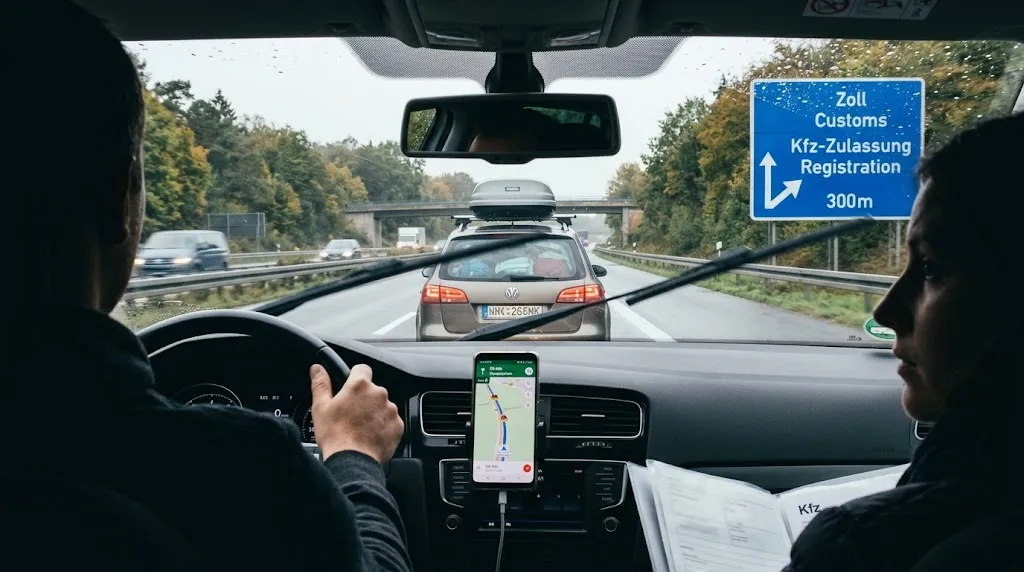
Your car can move to Germany with you – but not permanently with foreign number plates. As soon as you live in Germany, you must register it here. If you come from a country outside the EU, customs also plays a role: under certain conditions, importing your car is tax- and duty-free; otherwise you can quickly face several thousand euros in charges. And depending on where it was issued, your driving licence may only be valid for a limited time.
Key facts at a glance
- Registration: If you live in Germany, your car needs German registration. The one-year rule for foreign plates only applies to temporary stays.
- From the EU: no customs duty, but you must re-register the car at the vehicle registration office.
- From non-EU countries: duty-free import as relocation goods is possible if you have used the car yourself for at least six months and lived outside the EU for at least twelve months.
- Without the exemption: usually 10% customs duty plus 19% import VAT on the vehicle's value.
- Technical requirements: cars from outside the EU often need an individual approval and costly modifications.
- Driving licence: EU licences are valid indefinitely; licences from non-EU countries only for six months after taking up residence.
Can I keep driving with my foreign number plates?
Only briefly. According to the German Vehicle Registration Ordinance, a car registered abroad may be used "temporarily" in Germany for up to one year – but only if it has no regular location in Germany.
If you move to Germany and your car is now kept here, it has a regular location. You must then register it in Germany. Driving permanently with foreign plates risks fines, insurance problems and, in the worst case, tax claims.
Tip: Take care of registration in the first few weeks after registering your address.
Case 1: You are coming from an EU country
There is no customs duty within the EU. However, you must register your car with the German vehicle registration office (Zulassungsstelle).
You will usually need:
- ID card or passport
- Registration certificate (Meldebescheinigung – proof of your address in Germany)
- Foreign registration certificate(s), Part I and Part II if applicable
- EC Certificate of Conformity (COC) – very helpful, as it proves the technical data
- Proof of a valid general inspection (Hauptuntersuchung, "TÜV") – foreign inspections are not always recognised
- eVB number (electronic insurance confirmation) from a German car insurer
- SEPA direct debit mandate for vehicle tax
- Proof that the car belongs to you (e.g. purchase contract)
Note on new cars: If the car is no more than six months old or has driven no more than 6,000 kilometres, it counts as a new vehicle for tax purposes. You will then have to pay VAT in Germany.
Case 2: You are coming from a country outside the EU
This is more complicated, because customs is also involved.
Duty-free as relocation goods
Your car can be imported free of charges as relocation goods (Übersiedlungsgut). All of the following conditions must be met:
- You had your usual residence outside the EU for at least twelve consecutive months.
- You are moving your residence to Germany.
- The car belongs to you and you used it yourself at your previous residence for at least six months.
- You will continue to use it in Germany for the same purpose.
- You declare it to customs no later than twelve months after moving.
- You may not sell, rent out or lend the car for the first twelve months after import. Otherwise, the charges become payable retroactively.
For the declaration, use customs form 0350 ("Customs declaration for relocation goods"). Have proof ready: deregistration at your previous address, registration in Germany, foreign vehicle registration in your name and the purchase contract.
If the conditions are not met
If you bought the car shortly before moving or weren't abroad long enough, you will have to pay:
- Customs duty: usually 10% of the vehicle's value for passenger cars (including transport costs to the EU border)
- Import VAT: 19% on the vehicle value plus customs duty
Example: For a car worth €15,000, you would pay around €1,500 in customs duty and around €3,135 in import VAT – more than €4,600 in total.
The customs clearance certificate
After customs clearance, you receive a clearance certificate (Unbedenklichkeitsbescheinigung). Without it, the registration office will not register your car.
Technical inspection and modifications
Cars from non-EU countries often don't automatically meet European regulations. In that case, you need a full expert report under Section 21 StVZO (individual vehicle approval) from TÜV, DEKRA or another testing organisation.
Typical modifications, for example for cars from the USA or the Middle East:
- Orange instead of red rear indicators
- Headlights with European beam pattern
- Speedometer showing kilometres
- Rear fog light
- Emission values and noise levels
This can cost anything from a few hundred to several thousand euros. Get a quote before shipping the car.
Documents for registration
In addition to the documents listed in Case 1, you will need:
- Customs clearance certificate
- Expert report under Section 21 StVZO or manufacturer's data sheet
- Foreign vehicle documents, with certified translation if required
Insurance
Third-party liability insurance is mandatory in Germany. Without insurance, you won't get an eVB number – and therefore no registration.
Tip: Ask your current insurer for a no-claims certificate (proof of accident-free years), ideally in English. Some German insurers accept it – which can significantly reduce your premium.
Vehicle tax
After registration, you pay vehicle tax (Kfz-Steuer) every year. For passenger cars, it is based on engine size and CO₂ emissions and is collected by direct debit. Fully electric cars may be temporarily exempt under certain conditions.
Driving licence: how long can I drive with my foreign one?
| Issuing country | Validity in Germany | Conversion |
|---|---|---|
| EU or EEA country | unlimited | optional |
| Non-EU country listed in Annex 11 FeV (e.g. Japan, South Korea, Switzerland, certain US states and Canadian provinces) | 6 months after taking up residence | mandatory, without or with reduced testing |
| Other non-EU country | 6 months after taking up residence | mandatory, with theory and practical test |
With licences from non-EU countries, you also need a translation or an International Driving Permit while driving with them. The six-month period can only be extended in exceptional cases.
Driving without a valid German licence after the deadline is a criminal offence (driving without a licence). Apply for the conversion early – processing often takes several weeks.
Other everyday rules
- Low-emission zones: Many cities require a green emissions sticker (Feinstaubplakette). You can get it at inspection centres or the registration office.
- Winter tyres: Winter tyres are mandatory in icy, snowy or slippery conditions.
- Safety vest, warning triangle, first-aid kit: must always be in the car.
- Parking permits: In many city centres, you need a resident parking permit – and for that, German number plates.
Is it worth it?
Calculate beforehand whether bringing your car makes sense. Costs include:
- Transport (ferry, container or driving it over)
- Customs duty and import VAT, if applicable
- Expert report and modifications
- Registration, number plates, insurance and tax
Especially for older cars from non-EU countries, it is often cheaper to sell the car at home and buy one in Germany. For high-value or newer cars that qualify as duty-free relocation goods, bringing them can be worthwhile.
Common mistakes
- Buying the car shortly before moving: The six-month minimum use is not met – and the duty exemption is lost.
- Selling the car in the first year: Customs will then demand the charges retroactively.
- Driving too long with foreign plates: Not allowed once you live in Germany.
- Underestimating modification costs: Individual approval can be expensive, especially for cars from the USA or Asia.
- Missing the licence deadline: After six months, you are driving without a valid licence with a non-EU licence.
Frequently asked questions
Can I import my car before finding a flat? Yes, but you need a registered address in Germany for registration. Plan the transport so the car arrives after you've registered your address.
Do I need an appointment for registration? In most cities, yes. Book an appointment at the registration office early – waiting times can be several weeks.
What happens to my old number plates? That depends on your home country. Often you have to return the plates there or prove deregistration. Ask the registration authority in your home country.
Can I also bring a motorbike or motorhome? Yes. The customs and registration rules generally apply in the same way. For motorhomes, weight and licence category can raise additional questions.
Do the rules also apply to a company vehicle? No. The duty exemption for relocation goods only applies to privately used vehicles. Different rules apply to commercial vehicles.
Conclusion
Bringing your own car to Germany is possible, but it takes planning. From the EU, it is usually straightforward with a re-registration. From non-EU countries, check beforehand whether your car can be imported duty-free as relocation goods and what modifications are needed. And don't forget your driving licence: from many countries, you have to convert it within six months. If you calculate and plan early, you'll avoid costly surprises.
All information without guarantee. Rules, tax rates and deadlines may change – please check the current requirements with German customs, the vehicle registration office at your place of residence and the driving licence authority.