Language Certificates for Studying in Germany
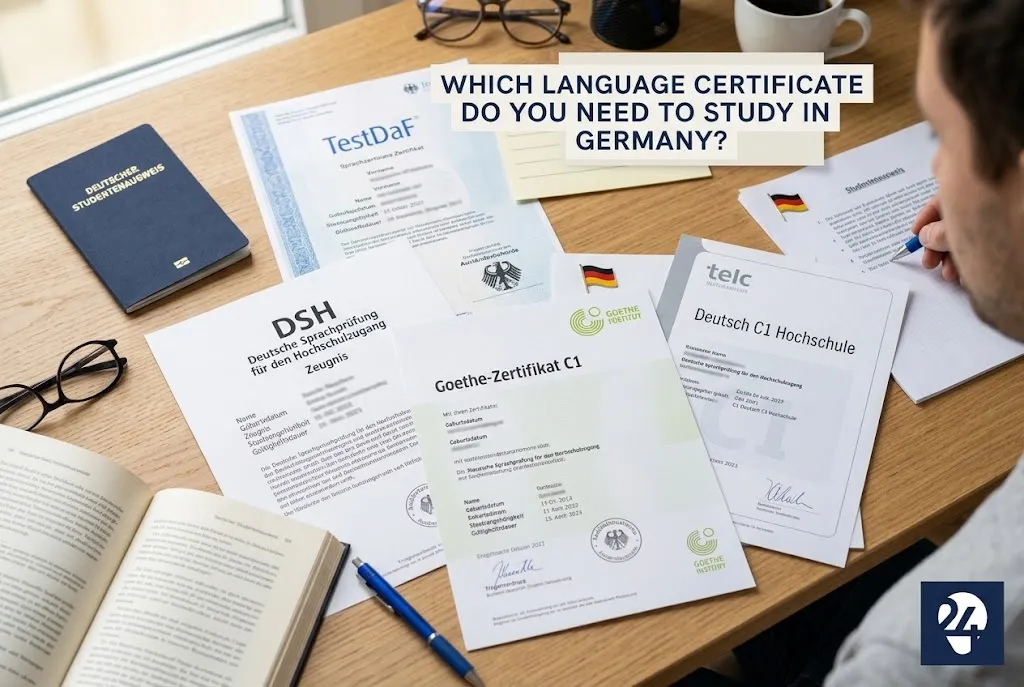
Language Certificates for Studying in Germany: TestDaF, DSH, Goethe, IELTS & TOEFL Explained
Before you can enroll at a German university, you need to prove that you speak the language of instruction well enough. Which certificate you need depends on one question: Is your program taught in German or in English?
German-taught programs: usually level C1
For most German-taught bachelor's and master's programs, universities expect German at around C1 level. The nationwide framework for German language exams lists these certificates as general proof:
| Certificate | Required result | Where to take it |
|---|---|---|
| TestDaF | TDN 4 in all four sections | Test centres worldwide (paper or digital) |
| DSH | DSH-2 (DSH-3 = very high level) | Only at German universities, usually after a prep course |
| Goethe-Zertifikat C2 (GDS) | Passed | Goethe-Institut worldwide |
| telc Deutsch C1 Hochschule | Passed | telc test centres |
| DSD II | Passed (level II) | Selected schools abroad |
| ÖSD C2 | Passed | ÖSD test centres |
| Feststellungsprüfung | German section passed | Studienkolleg in Germany |
Watch out: Many universities also accept the Goethe-Zertifikat C1 or other C1 certificates, but not all of them. Some accept B2 for certain programs, for example TestDaF with TDN 3 or DSH-1. Always check the exact list of your university and program.
TestDaF or DSH – which one is better?
- TestDaF is ideal if you are still abroad. You take it in your home country and apply with the result.
- DSH is offered only by German universities. It works well if you are already in Germany, for example in a university prep course. A DSH from one university is generally accepted by others, but not always – check first.
English-taught programs: usually B2 to C1
Many master's and PhD programs in Germany are taught entirely in English. The most common requirements are:
| Test | Typical minimum |
|---|---|
| IELTS Academic | 6.0–6.5 overall (competitive programs up to 7.0) |
| TOEFL iBT | 80–90 points (top programs 100+) |
| Cambridge (C1 Advanced / B2 First) | Depends on program |
| PTE Academic | Accepted by many universities |
| Duolingo English Test | Accepted only by some – don't rely on it |
Exemptions: If your school or previous degree was taught in English, or you come from an English-speaking country, many universities waive the test. You usually need a confirmation from your university.
Tip: Take IELTS Academic, not IELTS General Training – the general version is not accepted for university admission.
Do you need German for an English-taught program?
Usually not for admission. But some programs require basic German (A1–A2) by a certain semester, and almost all students benefit from it in daily life – at the Bürgeramt, with landlords and when looking for a student job. Many universities offer free or low-cost German courses.
Practical tips
- Check the requirements early. Requirements differ by university and even by program. Look at the program page or the DAAD database.
- Book your test in time. Test dates fill up quickly, and results take several weeks.
- Watch the validity. IELTS and TOEFL results are usually valid for two years. Some universities also reject German certificates that are older than two years.
- Avoid private language school certificates. Internal certificates from language schools are often not accepted for admission.
- Bilingual programs need both. Programs taught partly in German and partly in English require proof for both languages.
- uni-assist checks your documents. If you apply via uni-assist, upload a certified copy of your language certificate together with your application.
Bottom line
German-taught programs usually require C1 (TestDaF 4x4, DSH-2, Goethe C2 or telc C1 Hochschule). English-taught programs usually require IELTS 6.0–6.5 or TOEFL 80–90. The final decision is always made by your university – so check your program's requirements before you book a test.
Planning your move to Germany? The movein24 app guides you through every step – from university application to visa, Anmeldung and insurance – free and in 16 languages.