German Federal States
Germany and Its Federal States
Germany — officially the Federal Republic of Germany — is a federal republic made up of 16 states (Länder or, informally, Bundesländer). Each state has its own unique characteristics, landscape, and culture.
Federalism in Germany
Germany has a federal constitution, and its constituent states retain a measure of political and legislative independence.
Most states are governed by a cabinet led by a State Premier (Ministerpräsident), together with a legislative body known as the Landtag. Landtag representatives are elected every four or five years, depending on the state. The State Premier is selected by a majority vote of Landtag members. Each state also delegates representatives to the Bundesrat, Germany's upper house of parliament.
Certain issues, such as defence and foreign affairs, are the exclusive responsibility of the federal government, while others are shared between the states and the federation. Germany's Basic Law also gives states legislative authority over areas including culture, education, and job training. This is why, for example, the school system can differ significantly from one state to another.
City States, Area States, and Free States
The 16 states include three city states (Stadtstaaten) — Berlin, Hamburg, and Bremen — and 13 area states (Flächenländer).
Three states — Bavaria, Saxony, and Thuringia — also refer to themselves as free states (Freistaaten), an old German term meaning "republic".
A distinction is also often made between the western "old federal states", established after World War II, and the eastern "new federal states", which joined the Federal Republic on October 3, 1990.
The 16 Federal States of Germany
Since German reunification, Germany has had 16 federal states, each with its own landscape, culture, and traditions — from the beaches of Schleswig-Holstein to the Alpine foothills of Bavaria.
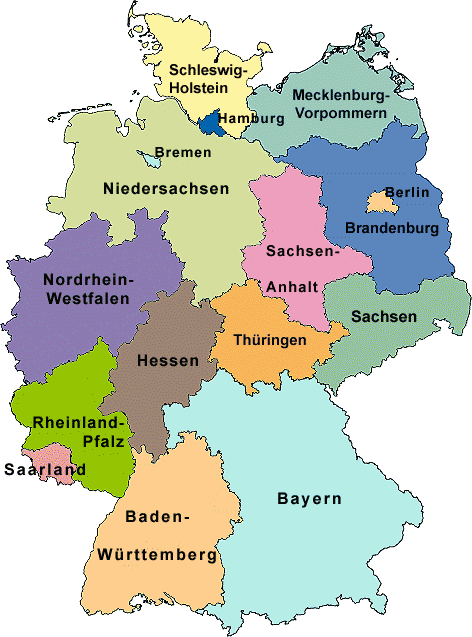
Below is a brief overview of each federal state.
Baden-Württemberg
Germany's youngest state, formed in 1952, Baden-Württemberg is a major manufacturing hub known for its forests, valleys, castles, and picturesque landscapes.
Bavaria
Bavaria is often associated with beer, Lederhosen, and Oktoberfest, but it is also a major center for the automotive and engineering industries.
Berlin
Since the fall of the Berlin Wall, Berlin has become a major destination for expats, known for its start-up scene, nightlife, cultural diversity, and creative industries.
Brandenburg
Surrounding Berlin, Brandenburg is one of Germany's least densely populated states. It is known for its lakes, forests, and rich biodiversity.
Bremen
Germany's smallest state consists of the cities of Bremen and Bremerhaven. It has a proud Hanseatic history and is known for its museums, maritime heritage, and medieval architecture.
Hamburg
Hamburg is a city state and major port city on the River Elbe. It is known for its maritime history, international trade, music scene, and cultural diversity.
Hesse
Hesse is home to Frankfurt, one of Germany's major financial centers. The state also features international business hubs, spa towns such as Wiesbaden, and scenic vineyards.
Lower Saxony
Stretching from the North Sea to the Harz Mountains, Lower Saxony combines coastal landscapes, rural areas, forests, and mountain scenery.
Mecklenburg-Vorpommern
With more than 2,000 lakes and an extensive coastline, Mecklenburg-Vorpommern is known for its beaches, natural landscapes, and relaxed pace of life.
North Rhine-Westphalia
Germany's most populous state has transformed from a traditional coal and steel region into a major center for research, technology, business, and industry.
Rhineland-Palatinate
Rhineland-Palatinate is one of Germany's most important wine-growing regions. It is known for its vineyards, Riesling, forests, and scenic river valleys.
Saarland
Located on the French border, Saarland has strong cultural and historical connections with France. Today, it is known for its diverse culture and European character.
Saxony
Saxony was once an important economic center of East Germany and is now known for its cultural heritage, historic cities, universities, and technology industries. It also played an important role in the peaceful revolution that contributed to the end of the GDR.
Saxony-Anhalt
Saxony-Anhalt is home to numerous UNESCO World Heritage Sites and is known for its historic towns, castles, cultural landmarks, and landscapes along the Elbe River.
Schleswig-Holstein
Germany's northernmost state is located between the North Sea and the Baltic Sea and has strong historical connections with Denmark. It is known for its beaches, lighthouses, islands, and coastal landscapes.
Thuringia
Located near the geographical center of Germany, Thuringia is known for its forests, historic towns, and cultural heritage. It is associated with figures such as Goethe and Bach and is home to numerous medieval landmarks.