Changing Your Degree, Switching Universities or Dropping Out: What Happens to Your Residence Permit?
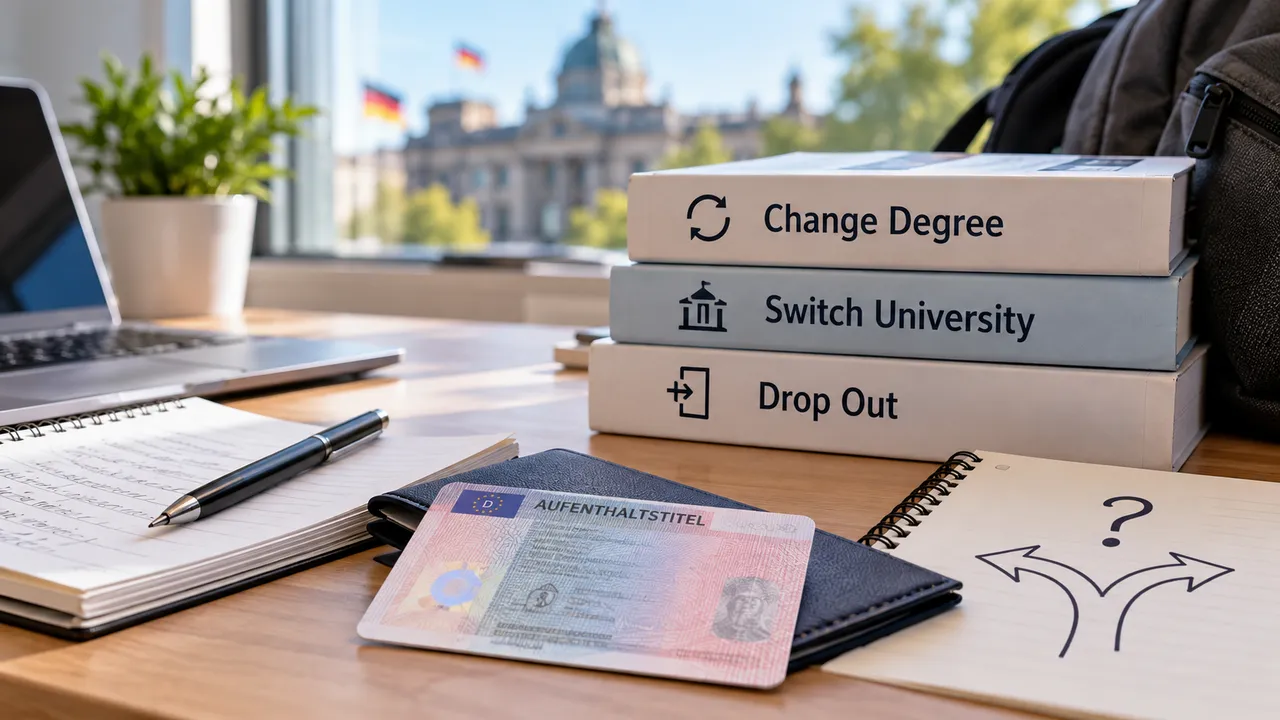
Good news first: changing your degree program or university in Germany is much easier today than it used to be. Even dropping out no longer means you automatically have to leave the country. But you still have to act fast, inform the Foreigners' Office (Ausländerbehörde) and get your residence permit updated.
This guide is for international students from non-EU countries who are planning to study in Germany or are already here. It explains what happens to your residence permit when you change subjects, move to another university or stop studying, and what your options are to stay.
In short:
- Changing your subject or university is allowed. You need a new admission and an updated residence permit.
- If you drop out, you can switch to a vocational training (Ausbildung), a job as a skilled worker or a new degree program without leaving Germany.
- You must tell the Ausländerbehörde within two weeks if your studies end early.
- Always apply for your new permit before your current one expires.
How the student residence permit works
As a non-EU student, you usually hold a residence permit for the purpose of study under Section 16b of the Residence Act (§ 16b AufenthG). The key word is purpose: your permit is tied to studying at a specific university in a specific program.
What you should know about it:
- Validity: usually two years, at least one year. If your program is shorter, it is issued only for the length of the program.
- Extension: granted if you haven't finished yet but can still finish within a reasonable time. The office may ask your university to judge your progress.
- Included in the purpose: preparatory language courses, the Studienkolleg and mandatory internships.
- Work: up to 140 full days (or 280 half days) per year, or up to 20 hours per week during the semester. Student assistant jobs at the university don't count.
Because the permit is tied to your study purpose, any change to what or where you study is relevant for the Ausländerbehörde.
Changing your subject or degree program
You realize after two semesters that Mechanical Engineering isn't for you and want to switch to Computer Science? That's possible.
What changed: In the past, German law strictly limited changes of purpose during a student residence permit. Changing your program was often treated as a problem, especially after the first semesters. Under the current rules, this ban has largely been removed. Courts confirm that you have a legal entitlement to a residence permit for your new program, as long as you are admitted and meet the usual requirements.
But: a change of program is still a change of your residence purpose. Your old permit does not simply carry over. You need to apply for a new or amended permit.
The Ausländerbehörde will typically check:
- your admission letter (Zulassung) or enrolment certificate for the new program
- your financing for the coming period (e.g. blocked account, scholarship or a formal obligation letter)
- valid health insurance
- whether you can realistically finish within a reasonable time
Watch out for repeated switches. One change is normal. Switching three times with few credits (ECTS) earned can make the office doubt that you will ever finish. Keep your transcripts ready and be able to explain why the new program fits you better.
Bachelor to Master is not a dropout but a new study purpose. Inform the office and apply for an extension with your Master's admission before your current permit expires.
Switching to another university
Moving from one university to another, for example from a university in Berlin to one in Munich, works like a change of program. You need an admission from the new university and an updated residence permit.
Two things are often overlooked:
- Your Ausländerbehörde may change. The responsible office is the one where you are registered (Anmeldung). Register your new address within two weeks of moving and contact the office in your new city.
- Costs can change. Some federal states charge tuition fees for non-EU students. In Baden-Württemberg, for example, non-EU students usually pay tuition fees per semester. Your financing proof must cover this.
If it's not your fault: Sometimes a program is closed or a private university loses its recognition. Before the office can revoke or shorten your permit for reasons you are not responsible for, the law gives you up to nine months to apply to another university.
Dropping out: your options to stay
If you leave university without a degree, your study purpose ends. Your residence permit does not disappear on the same day, but the Ausländerbehörde can shorten it afterwards (nachträgliche Befristung) or revoke it. If you have no new purpose, you will then have to leave Germany.
The important point: you can switch directly from a student permit to almost any other residence purpose, without leaving Germany and without applying for a new visa from your home country.
| Option | What you need | Legal basis |
|---|---|---|
| Start a new degree program | Admission to a new full-time program, financing, health insurance | § 16b AufenthG |
| Vocational training (Ausbildung) | Training contract with a company or a place at a vocational school; usually German skills (often around B1) | § 16a AufenthG |
| Job as a skilled worker | Job offer plus a recognized qualification, e.g. a degree or vocational training from your home country | § 18a / § 18b AufenthG |
| EU Blue Card | Recognized university degree (e.g. from your home country) plus a qualified job offer above the salary threshold | § 18g AufenthG |
| Job based on professional experience | Job offer plus substantial practical work experience, even without a formal degree | § 19c (2) AufenthG |
Not allowed: switching to a permit for short-term, unskilled seasonal or temporary jobs.
Vocational training is underrated. Many students don't know it: a three-year Ausbildung in IT, mechatronics, nursing or a commercial field is paid, in high demand and can lead to a permanent residence permit. Dropping out of university can be a fresh start, not a dead end.
Your duties: tell the office within two weeks
This is the rule most students don't know. If your studies end early, for example because you dropped out or were exmatriculated, you must inform your Ausländerbehörde within two weeks of knowing it (§ 82 (6) AufenthG). If you don't, you risk a fine and trouble with your next application.
Also important:
- Apply before your permit expires. If you apply in time, your stay counts as legal while the office processes your application (Fiktionsbescheinigung). If you apply too late, you may lose this protection.
- Keep proof. Send your notification in writing (email or letter) and keep a copy.
- Don't start a new job or training before you are allowed to. Check which work your current permit allows until the new one is issued.
- Don't wait and hope. The office often learns about an exmatriculation anyway. It's always better if they hear it from you, together with your plan.
Step-by-step checklist
- Talk to your university first. The student advisory service and the International Office can tell you if credits can be transferred and which programs fit.
- Secure your next step before you exmatriculate: a new admission, a training contract or a job offer.
- Check your financing for the new period (blocked account, scholarship or salary) and make sure your health insurance continues.
- Inform the Ausländerbehörde in writing within two weeks if your studies end early.
- Book an appointment and apply for your new or amended residence permit before your current one expires.
- Bring your documents: passport, current residence permit, biometric photo, new admission or contract, proof of financing, health insurance certificate, transcript of records, registration certificate (Meldebescheinigung).
- Moving city? Register your new address within two weeks and switch to the Ausländerbehörde there.
FAQ
Will I lose my residence permit immediately if I drop out? No. It stays valid at first, but the Ausländerbehörde can shorten it once your studies have ended. Inform them within two weeks and present your next step.
How often can I change my program? There is no fixed limit. But the office checks whether you can still finish in a reasonable time. Frequent changes with little progress can lead to a refusal.
Can I switch from university to an Ausbildung without going home? Yes. You can switch directly in Germany if you have a training contract and meet the requirements.
Can I just work full-time after dropping out? Not with a student permit. You need a new permit for employment, which usually requires a recognized qualification and a suitable job offer.
Do I need a new visa from my home country? Usually not. For most changes of purpose, you apply directly at the Ausländerbehörde in Germany.
I'm still abroad and not sure about my program. Should I worry? No. Choose carefully, but know that switching later is possible. Many international students change their program once.
This article provides general information and is not legal advice. Local Ausländerbehörden may handle individual cases differently. For your specific situation, contact your Ausländerbehörde, your university's International Office or a migration counselling service.
Sources